
Integrating Soil Literacy in Primary school subjects
In this module, discover how to embed soil themes into everyday lessons. Use soil moisture measurements to teach math skills, analyse folk tales about farming in literacy circles, or explore how soil colors inspire local art traditions. These connections save planning time while making abstract concepts tangible for young learners.
The following list of options might inspire you on how to integrate soil literacy in the subjects you teach. Choose one you like from the list and reflect on how you would implement it in your class.
Before getting into some experiements, check this 'what is dirt' video that can get kids inspired to learn and practice more.
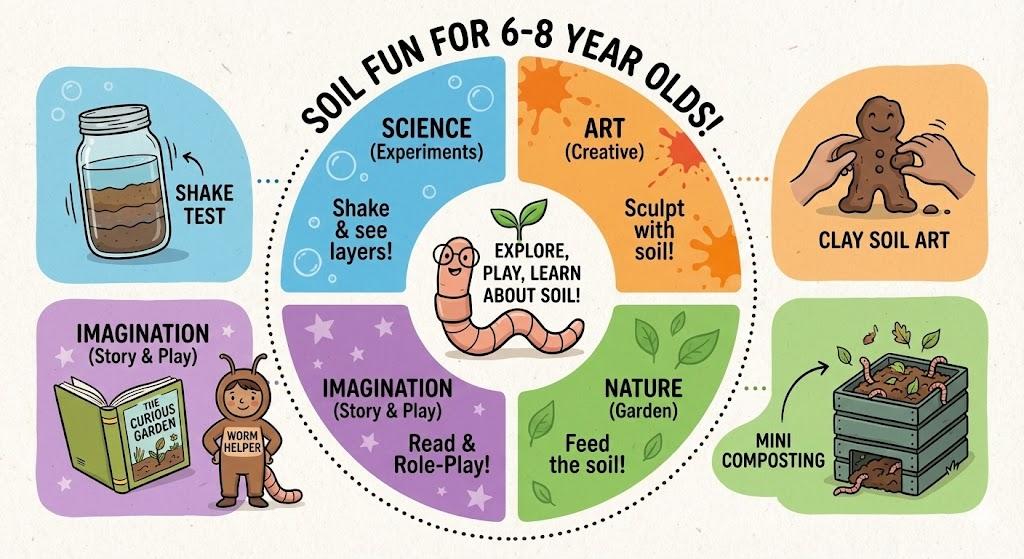
AGE GROUP: 6–8 year olds
Simple soil experiments:
Activity: Perform a "shake test" to observe soil layers. Have children fill a jar with soil, water, and dish soap, then shake it and let it settle to see the different layers form. Discuss what they observe.
Soil sensory play:
Activity: Create a sensory bin with different types of soil (e.g., sandy, clay, loamy) and let students feel the textures. Encourage them to describe the textures and discuss which soil feels best for planting seeds.
Story time with soil:
Activity: Read children’s books that focus on plants and soil, such as "The Curious Garden" by Peter Brown. After reading, discuss the role of soil in helping gardens grow.
Ecosystem dioramas:
Activity: Build simple dioramas showing different ecosystems and the role of soil in each. Use small toys, plants, and natural materials to illustrate how soil supports life.
Garden detectives:
Activity: Organize a garden scavenger hunt where students look for items like different soil colors, worms, rocks, and small plants. Use this to discuss how each item relates to soil.
Mini composting projects:
Activity: Create a small classroom compost bin with leaves, fruit peels, and soil. Let children observe the decomposition process and learn how organic matter enriches soil.
Clay soil art:
Activity: Let students use natural clay (from soil) to mold and create simple sculptures. Discuss how clay is a type of soil with different properties than sandy or loamy soil.
Plant growth charts:
Activity: Plant seeds in cups of different soil types. Have students predict and chart which soil type will help the seed grow best, and observe over several weeks.
Role play – soil helpers:
Activity: Assign roles like "soil scientist," "worm helper," or "plant protector" and do a role-play activity where children act out how they help soil in a garden ecosystem.
Interactive soil songs and games:
Activity: Teach a simple song about soil with movements, or create a game where students can "dig" for imaginary soil treasures and learn facts as they play.
SOIL SONG
Soil, Soil, in the Ground
(To the tune of "Twinkle, Twinkle, Little Star")
Soil, soil, in the ground,
Where the roots are spread around.
Plants and worms call you home,
Helping seeds so they can grow.
Soil, soil, dark and deep,
In your care the earth you keep.
Dirt and pieces, small and fine,
Mixed with water, roots entwined.
In the garden, fields, and more,
Soil is life beneath the floor.
Soil, soil, in the ground,
Where the roots are spread around.
AGE GROUP: 9–14
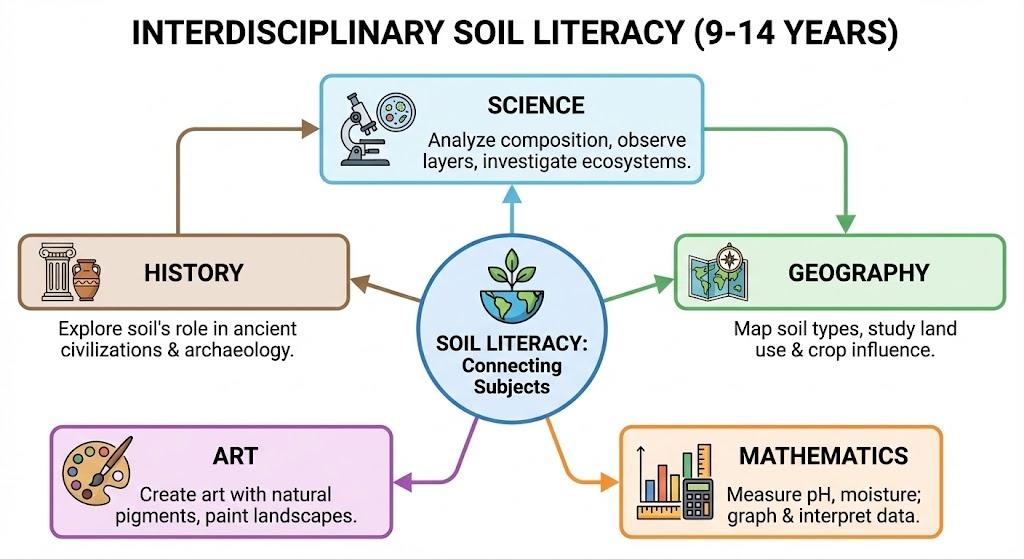
Science: soil composition and ecosystems
Activity: Conduct a hands-on soil investigation where students collect soil samples, observe different soil layers, and examine soil particles under a microscope. Discuss the importance of soil in ecosystems.
Geography: soil and land use
Activity: Create a map project where students identify different types of soil in Europe and discuss how soil types influence the kinds of crops that can be grown in each region. Include discussions on local soil characteristics.
Mathematics: measuring and graphing soil data
Activity: Have students measure the pH levels, moisture content, and temperature of different soil samples. Use the data to create graphs and charts to interpret and discuss findings.
Art: creative soil creations
Activity: Encourage students to create art using natural soil pigments. They can collect different soils to see the variety of colors and use them to paint landscapes or create textured art pieces.
History: soil and ancient civilizations
Activity: Discuss the role of soil in ancient European civilizations, such as the effect of fertile land on the Roman Empire. Explore archaeology projects involving soil tools and settlement studies.
Environmental studies: soil conservation
Activity: Plan a field trip or a virtual tour of a local farm or nature reserve to learn about soil conservation practices. Follow up with a classroom discussion on how students can help protect soil health.
Literature: storytelling with soil
Activity: Assign a creative writing project where students write stories or poems from the perspective of soil, capturing its journey through different seasons and its interactions with plants and animals.
Biology: understanding soil biodiversity
Activity: Conduct a soil biodiversity hunt where students collect samples and identify soil organisms such as earthworms, beetles, and microbes. Discuss the ecological roles these organisms play.
Technology: analyzing soil data
Activity: Use digital tools and apps to connect with scientific databases on soil health. Have students track changes over time in soil quality and environmental data related to local areas.
Physical education: garden-based learning
Activity: Initiate a school garden project where students plant and care for vegetables. Use gardening as a practical method to teach about the importance of healthy soil and sustainable agriculture.
Do you have more ideas of how to integrate Soil topics into everyday subjects?
Share your ideas in the forum and interact with your peers.


There isn't a link to the "there is dirt video" mentioned on the first paragraph.
Made you can add this book about "Soil experiments or kids" by FAO openknowledge.fao.org/items/0abb8798-ec5f-4718-af45-730e7...
Here we can also suggest adding the virtual tour app to the World's Soil Museum at Wageningen University which CURIOSOIL is developing or this link can be used for another platform https://wsm.isric.org/tour.html
The "forum" link isn't working yet. We get an error.