
Creating a school project on Soil Literacy
With allies identified, Section 3 helps you channel that collaboration into action. Design a soil project tailored to your school’s space and schedule, whether it’s a month-long worm composting experiment or a single art lesson using soil pigments. Templates and case studies will guide you in creating activities that fit your reality.
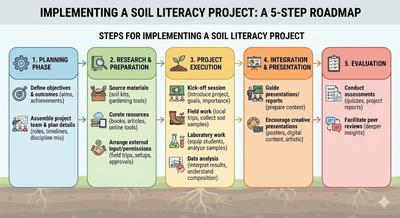
Engaging primary school students in a soil literacy project enhances their understanding of the environment, agriculture, and sustainability. Following these steps will help you create a comprehensive and impactful soil literacy project that offers your students meaningful learning experiences while fostering an appreciation for the natural world.
Before starting your project, consider the pros and cons. This will help you advocate your idea to school stakeholders (your school head, parents, colleagues).
Pros:
-
Hands-on learning: Encourages active participation and experiential learning.
-
Interdisciplinary approach: Integrates science, geography, art, and more.
-
Environmental awareness: Promotes understanding of ecological balance and conservation.
-
Skill development: Enhances observation, analytical, and teamwork skills.
-
Local focus: valuing the students' context and the local outdoors
-
Community Involvement - The project could partner with local farms, environmental groups, or conservation initiatives to give children real-world experiences with soil protection, enhancing the impact of the lessons taught in class
Cons:
-
Resource intensive: Requires materials and time for proper implementation.
Solution: Start with a scalable project by using readily available resources. Partner with local gardening centres or environmental organizations to borrow materials or receive donations. Crowdsource materials from parents or the school community.
-
Weather dependency: Outdoor activities may face disruption due to bad weather.
Solution: Plan for indoor backup activities, such as soil testing experiments or using virtual garden simulation software. Set up a small indoor garden using pots or window planters that can be maintained regardless of weather conditions.
-
Safety concerns: Handling soil and tools needs supervision to prevent accidents.
Solution: Conduct a safety briefing at the start of the project. Use child-safe tools and ensure adult supervision during all activities involving soil or gardening tools. Organize the students into small groups with sufficient adult supervision to ensure safety standards are maintained.
-
Knowledge gap: You might need extra preparation to cover specialized content.
Solution: We’ve got you! Whatever you need to know you will learn by completing this MOOC. If you wish to learn even more, check out the other MOOC of the Curiosoil project (LINK) or reach out for help here (LINK).
Before exploring Steps of Action, get inspired by some kids gardening activities here.
Steps of action
1. Planning
|
2. Introduction
|
3. Engagement
|
4. Execution
|
5. Documentation
|
6. Presentation
|
7. Evaluation
|
8. Reflection
|

Write a short reflection on which of these steps you will implement and how.
Check out this training (also from an EU funded project) and learn more ideas to train soil stewards.

Links are missing on the "CONS" > "knowledge gap" > "Solution" sentence.
Also on the above sentence, CURIOSOIL must be in all caps as per the project's visual identity guidelines.
Point 8 is not on bold and isn't formatted properly.