
Active Learning and Citizen Science
Now, let’s channel inclusion and safety into action. Section 4 focuses on active learning and citizen science, where students move from passive observers to soil advocates. Explore how to integrate low-cost, high-impact projects, like local soil testing or digital storytelling about land stewardship, that align with curricula while fostering civic agency. These methods honour secondary students’ growing autonomy, showing them their voices matter in shaping a sustainable future.
Active learning is an educational approach that emphasizes students' direct engagement with the material, fostering deeper understanding and retention. Integrating active learning into your teaching practice can enhance students' critical thinking, problem-solving, and collaborative skills. This method involves moving beyond traditional lectures to incorporate activities that require students to actively process and apply information.
A key aspect of active learning is the application of theoretical concepts to real-world contexts.
By bridging the gap between theory and practice, students gain valuable insights into how their classroom knowledge applies to societal challenges. This approach not only enriches learning but also prepares students to become informed, proactive citizens.
Citizen science is a compelling extension of active learning, empowering students to contribute to genuine scientific research. By participating in citizen science projects, students engage meaningfully with scientific methodologies and contribute to data collection and analysis. These projects foster a sense of ownership and responsibility, encouraging students to apply their learning to benefit society.
To integrate authentic citizen science and civic engagement into your curriculum, the HUMUS Project's "Soil Stewards" initiative offers an interesting framework. By providing structured protocols, training, and tools, it enables educators to guide students in collecting valuable scientific data on local soil health . By connecting local soil data to broader EU sustainability goals, the project naturally fosters civic awareness. Students see how their scientific work informs larger conversations about land use, food security, and climate policy, demonstrating the power of collective action and empowering them as informed, engaged citizens capable of contributing to solutions for planetary challenges.
Here are some good practices that exemplify active learning and the application of theoretical concepts in real contexts through citizen science:
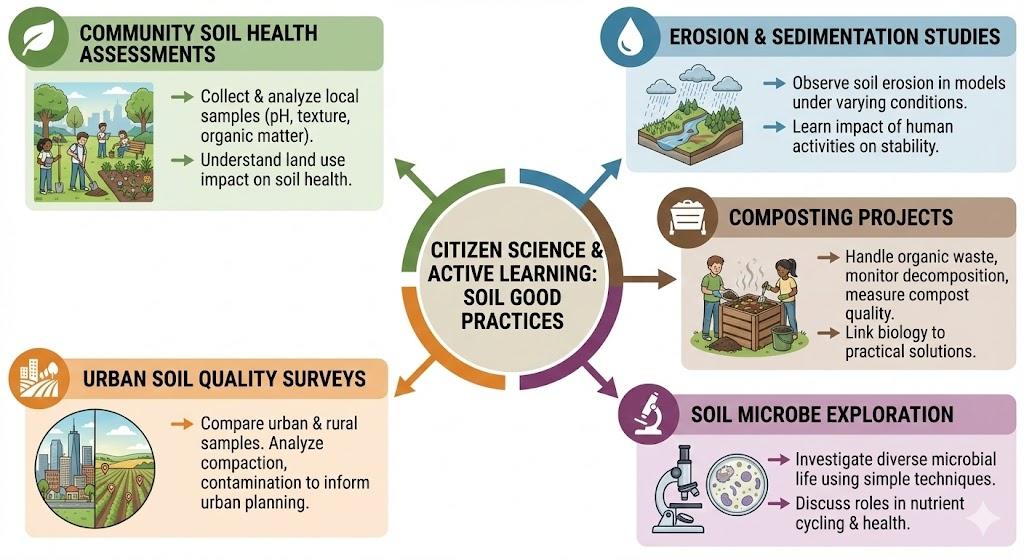
- Community soil health assessments: Organize students to collect and analyse soil samples from various local habitats, such as gardens, parks, and agricultural fields. By testing for soil pH, texture, and organic matter content, students can apply soil science concepts to understand the influence of different land use practices on soil health. This hands-on activity encourages critical thinking about sustainable land management.
- Erosion and sedimentation studies: Set up simple experiments where students create models to observe soil erosion under different conditions, such as varying vegetation cover or rainfall intensity. By connecting theoretical principles of erosion to visible results, students learn about the impact of human activities on soil stability and the practical measures to prevent it.
- Composting projects: Implement a school composting program where students handle organic waste, monitor decomposition stages, and measure the quality of the resulting compost. This project links classroom learning about biological processes and nutrient cycling with practical environmental solutions that enhance soil fertility and reduce waste.
- Soil microbe exploration: Involve students in investigating the diverse microbial life present in soil samples. Using simple microbiology techniques, students can cultivate and identify microorganisms, discussing their roles in nutrient cycling and plant health. This exploration deepens understanding of the unseen biodiversity within soil and its ecological importance.
- Urban soil quality surveys: Guide students to examine the impact of urbanization on soil quality by comparing samples from urban and rural areas. Analysing differences in soil compaction, contamination, and organic content reveals crucial insights into urban planning and sustainable development.
How would you use active learning in your class when teaching about soil? Write a short reflection!
Reflection
‘Tell the story of that soil’: write a creative piece or a research story about the ‘life’ of that soil - where it comes from, what organisms live in it, what crops grow there and how it might change in the future. This approach can encourage empathy for natural systems, creativity and the integration of scientific and narrative thinking.
Conclusion
Soil literacy is more than a subject, it’s a catalyst for connection. This module has equipped you with strategies to transform your classroom into a space where diverse learners see themselves in the story of soil, where trauma-informed practices foster safety, and where citizen science turns abstract concepts into tangible action. By prioritizing inclusion and student agency, you’re not just teaching about soil health; you’re modeling how to engage with complex global issues thoughtfully and equitably. For secondary teachers, this work is critical: adolescents are forming their identities as citizens, scientists, and stewards. Your lessons can help them navigate climate anxiety with purpose, grounding fear in actionable hope.
The tools you’ve explored in this module, universal design frameworks, trauma-conscious scaffolding, and citizen science projects, are not extra tasks. They’re ways to simplify your practice by meeting students where they are. A soil pH lab becomes a dialogue about environmental justice. A composting project doubles as a lesson in collaboration. As you move forward, remember that small, intentional shifts, like offering choice in assessments or partnering with a local NGO, can ripple outward, shaping not just skilled learners, but empathetic advocates for the Earth. You hold the seeds; let this module be your toolkit for helping them grow.

The unique video from this module is from another project's MOOC. Why this option?