
The whole school Approach
Parents invested? Now expand their role from supporters to co-architects. Section 2 shifts to whole-community engagement, where local farmers, businesses, and elders become governance partners. Learn to structure "Soil Stewardship Councils" that share ownership (e.g., a cafe owner donating compost bins, a retired agronomist advising student labs). This isn’t volunteerism, it’s resource diplomacy, converting community goodwill into tangible assets while distributing leadership burdens.
The Whole School Approach (WSA) is an educational strategy that involves collective and collaborative action among learners, staff, and the broader community to enhance learning, behavior, and wellbeing across the entire school environment, fostering inclusivity and community involvement.
This short animation shows an example of a WSA working:
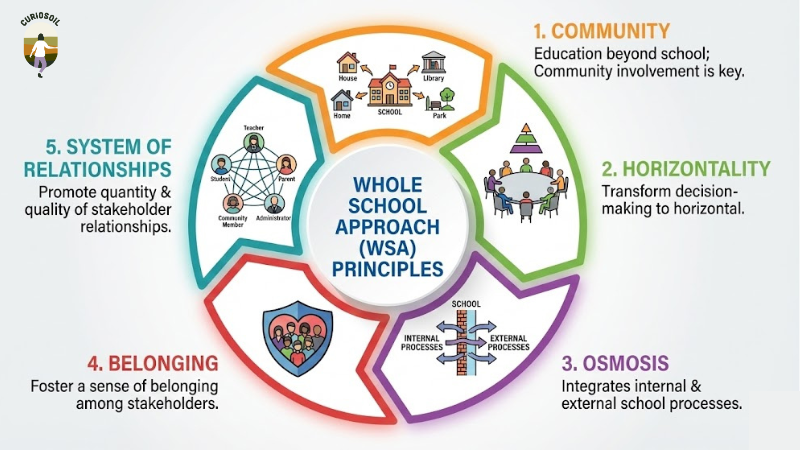
Principles of WSA:
- Community: Education extends beyond school; community involvement is key.
- Horizontality: Transform decision-making processes from hierarchical to horizontal.
- Osmosis: Integrates internal and external school processes.
- Belonging: Schools should foster a sense of belonging among stakeholders.
- System of relationships: Promote both the quantity and quality of stakeholders' relationships.
Challenges:
- Community outsiders: Professionals may lack community integration; mutual cultural understanding is needed.
- Social class: Aim for equity but integrate diverse social groups.
- Digital: Question virtual community effectiveness in WSAs.
- Sustainability: WSA processes are sensitive to change; long-term sustainability is complex.
- Participation: Crucial for WSA; requires reformulating participation, reconstructing spaces, and rethinking strategies to enhance stakeholder involvement.
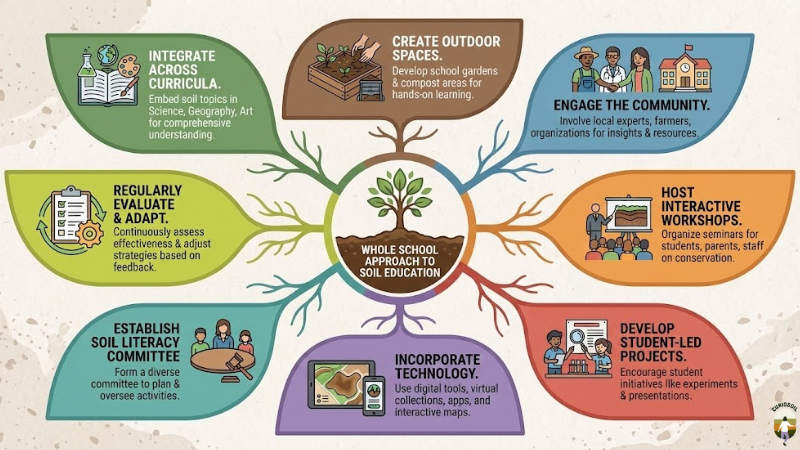
The following practical tips can help you implement the whole school approach:
Integrate soil education across curricula:Embed soil-related topics into various subjects like science, geography, and art to provide students with a comprehensive understanding of soil ecology and its significance. |
Create outdoor learning spaces:Develop school gardens or composting areas where students can engage in hands-on learning about soil health, sustainability, and biodiversity. |
Engage the community:Involve local experts, farmers, and environmental organizations to participate in school programs, providing insights and resources for soil-related projects. |
Host interactive workshops:Organize workshops and seminars for students, parents, and staff to learn about soil conservation practices and the role of healthy soil in the ecosystem. |
Develop student-led projects:Encourage student-led initiatives that focus on soil activities, such as soil testing experiments or community presentations on soil preservation. |
Incorporate technology:Use digital tools and platforms to explore soil science, like virtual soil collections, soil health monitoring apps, and interactive modeling tools. Encourage students to explore soil data online, engage with interactive maps, and analyze soil conditions globally. |
Establish a soil literacy committee:Form a committee with teachers, parents, and students to plan and oversee soil literacy activities, ensuring diverse input and sustained engagement. |
Regularly evaluate and adapt:Continuously assess the effectiveness of soil literacy initiatives and be open to adapting strategies based on feedback and changing educational needs.
|
Check out this MOOC to learn more about Teaching Sustainability Awareness from a whole systems perspective



The text on the paragraphs on the right is partly hidden under the column next to it (with Course and Notes)
I found the last part of this chapter understandable ('The following practical tips can help you implement the whole school approach:'). The part before I found less clear, including the video that did not reveal for met what the concept of WSA entails other than creating chaos is the University...