
Universal Design and Student-Centred Teaching Methods
Inclusion starts with intention—but thrives through design. Building on the considerations from Section 1, Section 2 introduces universal design strategies tailored to classrooms. Discover how to adapt soil activities (like sensory bins or seed-planting) for varying motor skills, language levels, and attention spans. These methods aren’t about “extra work”—they’re about simplifying your planning by embedding flexibility from the start.
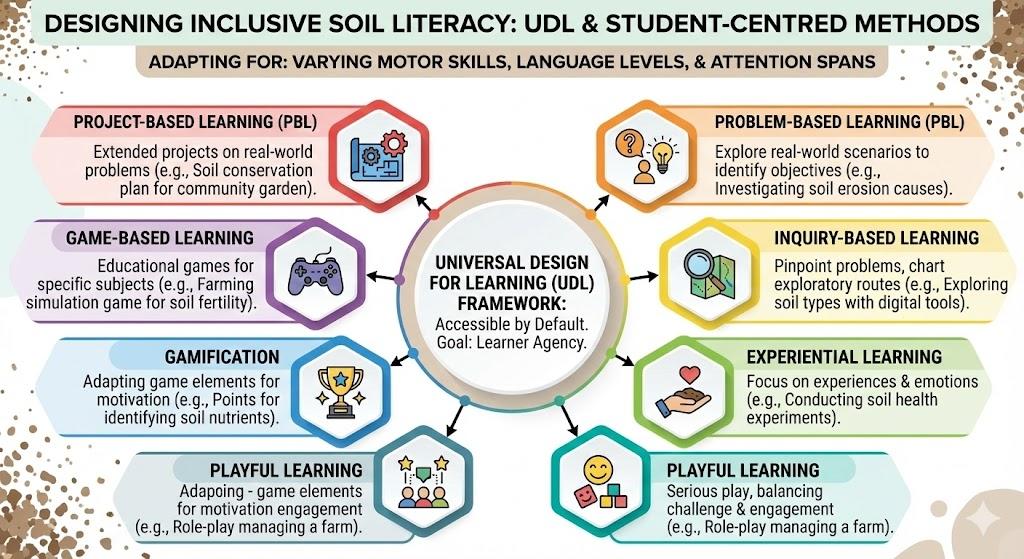
Universal Design for Learning is a framework aimed at optimizing teaching and learning for everyone, leveraging scientific insights into how humans learn. The goal of UDL is learner agency that is purposeful and reflective, resourceful and authentic, strategic and action-oriented. Learn more here.
Student-centred teaching methods engage children as active participants in the classroom, ensuring their involvement in both planning and evaluation of innovative school programs.
Check out the following methods:
-
Project-based learning involves students working on extended projects that tackle real-world problems. This method develops deep content knowledge along with critical skills like thinking, collaboration, and communication. For example, students might create a soil conservation plan for a community garden, allowing them to apply their knowledge to practical soil literacy challenges.
-
Problem-based learning (PBL) has students identify learning objectives by exploring real-world scenarios. This approach inverts traditional learning by empowering students to explore topics they deem necessary. An example of this method in action is investigating causes of soil erosion and developing solutions that can be implemented in local communities. PBL typically follows the Maastricht seven-jump process: understanding the problem, identifying questions, brainstorming current knowledge and potential solutions, structuring the results, setting learning objectives for missing knowledge, conducting independent study, and discussing findings with the group.
-
Inquiry-based learning offers students the opportunity to pinpoint problems and chart out their own exploratory routes, making it particularly suitable for digitally supported learning. An instance of this approach might involve students exploring different soil types in local parks and documenting their findings using digital tools, thereby enhancing soil literacy through independent research and discovery.
-
Experiential learning focuses not just on learning outcomes but also on the experiences and emotions of students during their learning journey. This method is particularly valuable for environmental topics that might otherwise be distressing. For example, students conduct soil health experiments that allow them to understand environmental impacts, linking emotional engagement with educational content.
-
Playful learning introduces serious play to the educational process, fostering an ideal learning state that balances challenge and engagement. By emphasizing joy, largely informed by Csíkszentmihályi’s flow theory, it adds a joyful element to serious learning. Students might role-play managing a farm with a focus on soil health, experiencing joy through achievement and surprise.
-
Gamification adapts game elements to enhance learning activities, boosting interest and motivation without necessarily incorporating actual games. In a classroom setting, this could mean students earn points for identifying soil nutrients accurately, while not being penalized for incorrect answers, thus maintaining motivation and focus on learning goals.
-
Game-based learning incorporates game-like activities intrinsically into the learning process. Educational games are purposefully designed to teach specific subjects. For instance, students might engage with a farming simulation game where they manage soil fertility, gaining hands-on experience in agricultural practices and soil management strategies.
These methods should be adaptable to meet individual students' needs. Teachers must genuinely believe in and be comfortable with the methods they apply. Offering students a choice in their teachers and learning methods, supported by incentives for schools, can facilitate tailored and effective educational experiences.

In the quiz the feedback does not include explanations in a similar way as in the previous quiz lesson.
In the playful learning there is a mistake in "adapting" word. It is not clear the distinction between gamification and playful learning. In addition, the playful learning is represented twice. Overal, the distinction of those methods is well represented in the picture.