
Greening the curriculum: Soil Literacy Integration
Advocacy opens doors; Section C of Module 2 ensures what’s taught inside them reflects your vision. Guidance on Greening the Curriculum provides templates to audit existing programs, integrate soil concepts across subjects (e.g., linking soil chemistry to math data units or land history to social studies), and train staff without overwhelming them. Forget top-down mandates, focus on scalable "lighthouse projects" that model success and attract organic adoption.
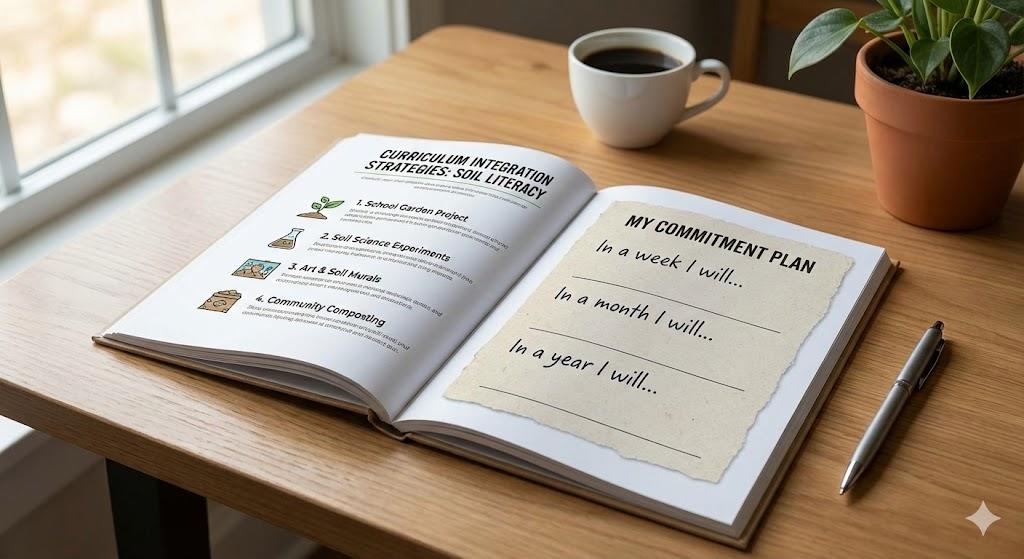
Read the following tips on how soil literacy can be integrated into your curriculum. Choose at least one that you like best and think you could implement and commit to take steps forward by finishing the three sentences:
-
In a week I will…
-
In a month I will…
-
In a year I will…
Post your reflections in the forum and comment on at least one peer’s plan.
1. Develop a school-wide vision:
Hold a vision-setting workshop with teachers and students to brainstorm ideas for integrating sustainability, focusing on creating a school greenhouse as a central project (e.g. organise a visioning workshop with teachers and students with the aim of co-creating a plan to build a school greenhouse as a flagship project for sustainability).
2. Establish interdisciplinary curriculum connections:
-
In Science, conduct soil erosion experiments and explore organic vs. inorganic soil components in classroom labs.
-
In Geography, map soil types in the local area and analyze how they have shaped local agriculture and settlement patterns.
-
In History, research and present on ancient farming techniques and their reliance on soil health, such as the three-field system in medieval Europe.
3. Integrate Soil Literacy in Mathematics and Technology:
-
Use soil sample composition to calculate percentages and graph results in Math classes.
-
Develop a Technology project where students build simple sensors or coding tools to measure soil moisture or pH levels.
4. Enhance literature and art projects:
-
Assign Literature classes to write essays or short stories from the perspective of soil during different historical periods.
-
In Art, create a mural using natural dyes made from different soil samples, illustrating local ecosystems or community history.
5. Promote experiential learning:
-
Develop a student-run school garden where different classes can plant and maintain plots based on lessons learned in class.
-
Organize field trips to nearby farms for students to learn about practices like crop rotation and permaculture roadside.
6. Encourage community and parental involvement:
-
Host a community gardening day inviting local horticulturists to discuss soil care, encouraging intergenerational knowledge exchange.
-
Parents can participate in workshops where they and students work together on sustainable practices like composting at school.
7. Provide professional development:
-
Organize teacher workshops with local environmental scientists discussing new research in soil conservation.
-
Facilitate peer-learning sessions where teachers share successful soil literacy lesson plans and outcomes.
8. Implement green education policies:
-
Launch a school-wide composting program, turning food waste into valuable soil amendments for the school garden.
-
Set a challenge for each class to reduce their carbon footprint, presenting findings at a school assembly.
9. Utilize creative assessment methods:
-
Use student presentations on soil biodiversity as part of their assessment in Biology.
-
Facilitate science fairs where projects focus on innovative uses of soil in sustainable agriculture.
10. Foster global connections:
-
Partner with a school in another country to compare soil health practices across diverse climates and cultures.
-
Engage students in global online forums discussing international soil conservation efforts.
11. Reflect and adapt:
-
Schedule bi-annual curriculum reviews where professional educators assess the impact of soil literacy projects and integrate student feedback to refine future efforts.
-
Keep faculty informed about new soil and sustainability-related educational resources.

Reflection task
How does this activity fit into your subject and school context?
Share your commitments for 1 week, 1 month and 1 year...
You can also comment on another colleague's plan and offer a suggestion or encouragement :)
 Please log in or register to post a comment