
Advocacy in 3 steps
|
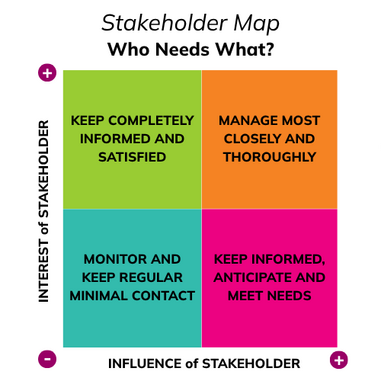
Module 2 Section B, Advocacy in 3 Steps, translates your objectives into persuasive narratives for key stakeholders. Learn to frame soil literacy in terms that resonate: for district officials (compliance with sustainability mandates), parents (student well-being and hands-on learning), or skeptical teachers (reduced planning time through cross-curricular links). You’ll craft talking points that turn resistance into buy-in. Step 1 Stakeholder mapping Identify stakeholders: List all individuals and groups involved in decisions related to soil literacy at your school: teachers, parents, local authorities, environmental organizations, etc. Categorize stakeholders: Use this stakeholder map to place them into quadrants based on influence and interest.
For each target group (and in the case of very influential people e.g. a minister or mayor, each target) make decisions on which quadrant they belong to and what tools can be used for engaging them answering a few simple questions: |
 |
1. What do they know about soil literacy in your context?
If you provide too basic information, that may be redundant and you lose their interest. If you do not ensure a common ground, it can cause problems later on.
2. What beliefs may influence them in supporting your goal?
How do they see the goal of schools? Do they see the benefits of student-centred methods? Do they believe in shared leadership? Do they like to control things? Do they truly support child rights? Do they know the limits of the schools’ responsibility? – you can ask these questions and similar ones here.
3. What personal interests can have an impact on their support?
Do they have children who may participate? Are they up for re-election? Could it offer media coverage for them? – and similar factors can have major influence
4. What can be the impact of their support on your goals?
It is important to understand how their direct support can help you in implementing a soil literacy programme, but it is equally important to see what might be the impact of their not doing anything or directly acting against your goals.
Have a look at these Miro templates to start mapping out the stakeholders.
Step 2 SWOT analysis
SWOT analysis is a simple and well-known tool. If done properly, it can be the basis of your
advocacy work (and the method can be used for other goals, too.)
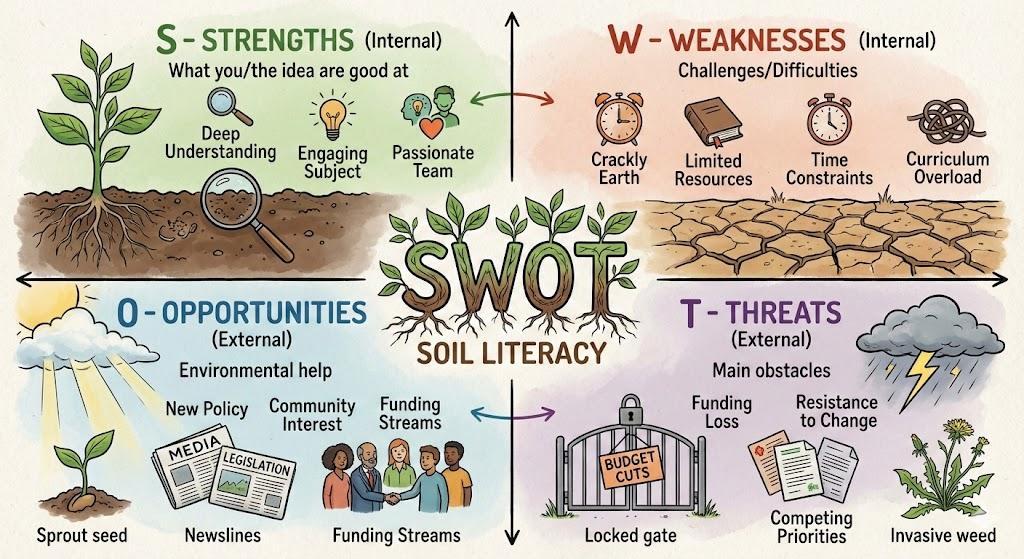
SWOT is another acronym that stands for:
-
Strength – what you or the idea (in this case, soil literacy) you are trying to convince people about is good at.
-
Weaknesses – what can the challenges be, what may be too difficult to embrace or implement, what may need to much effort.
-
Opportunities – what element of the environment (media coverage, legislation in the pipeline, wish to change) can help the realisation of what you want to achieve.
-
Threats – what are the main obstacles that can be in your way.
It is important to remember that Strengths and Weaknesses are internal, you may even be able to improve and eliminate some weaknesses, while Opportunities and Threats are external, they do not depend on you, and it may take a lot of advocacy effort to minimise threats.
Perform a SWOT analysis of the policy environment, the institutional environment, financial provisions and the public opinion in your own context (your school) to assess what are the main barriers to achieve your goal, and what are the supporting factors. You can learn more about SWOT analysis here.
Step 3 Identify your tools
Once you have reviewed the target groups, the enabling factors and the barriers in your environment, it is time to assess what tools to use to promote your messages.
Are there some established channels to decision makers? You might just need to specify your messages or be more mindful to use them as an advocacy tool.
Examples of advocacy tools already there:
-
International treaties and policy documents – use relevant quotes
-
Research articles
-
Outcomes that you can share – better learning outcomes, higher level of well-being, etc. proven by piloting activities
-
Photos – but please, be aware of children’s privacy rights and never share photos with recognisable people in them!
-
Media articles
-
Methodology already developed
What needs to be developed
Examples of advocacy tools that you can provide:
-
Testimonials
-
Own research outcomes
-
Infographics of what you are promoting
-
Videos, audios, photos – again being mindful of privacy rights
-
Newsletters
-
Website
-
Social media posts
 Please log in or register to post a comment