
Integrating Soil Literacy in Secondary School Subjects
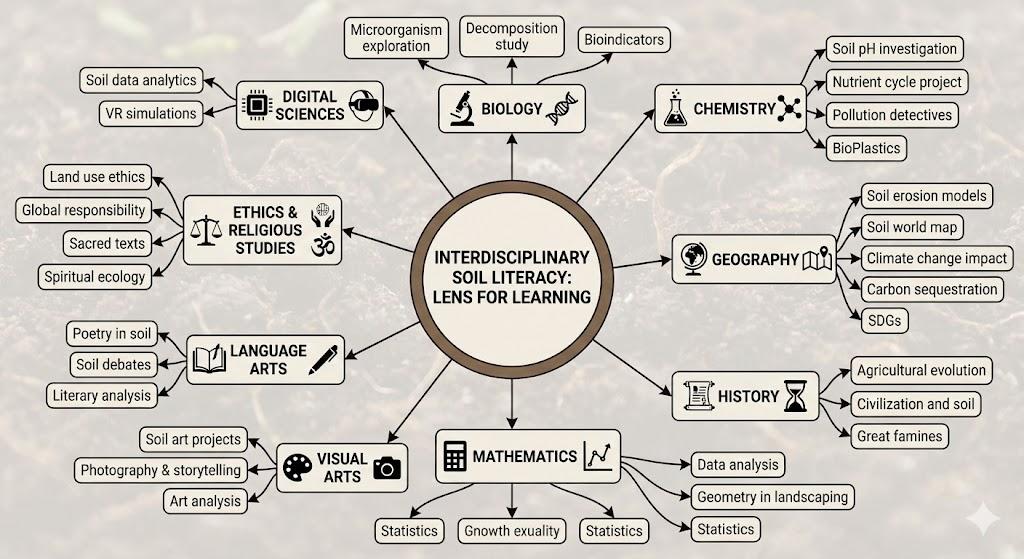
Soil literacy isn’t confined to isolated projects, it’s a lens for interdisciplinary learning. This Section shifts focus to integrating soil concepts across secondary school subjects.
Discover how to align soil themes with existing curricula, whether through data analysis, historical contexts, or social and ethical discussions. These strategies help students recognize soil’s role in interconnected systems, bridging classroom theory to global challenges like food security and climate resilience.
The following list of examples might inspire you on how to integrate soil literacy in the regular subjects.
Choose one from the list and reflect on how you would implement it in your class. Share your thoughts and ideas on the class forum and engage with your peers.
Before getting into some experiements, check this 'what is dirt' video that can get kids students inspired to learn and practice more.
The challenge may be to bring as many subject teachers to pull on the same string and include soil literacy into their own subject teaching as well as where and how to integrate and systemically weave the experiences and learnings together, which will likely be best through integrative projects (with participation from different subject areas) - see section 5.
Examples for soil literacy projects grouped according to curricular connection
Biology
-
Microorganism exploration: Task students with identifying and classifying soil microorganisms through microscopic analysis. Have them create a biodiversity map illustrating different organisms' roles in soil health.
-
Decomposition study: Develop a composting experiment where students investigate the decomposition rate of organic materials and its effect on soil nutrient content.
-
Study of bioindicators: Identify earthworms and other organisms as indicators of soil health.
Chemistry
-
Soil pH investigation: Conduct experiments to measure the pH of different soil samples and research how acidity or alkalinity affects plant growth. Discuss chemical treatments to alter soil pH and their environmental impacts.
-
Nutrient cycle project: Create a visual cycle of essential soil nutrients. Students can explore processes like nitrogen fixation and its importance to plant growth, with practical demonstrations using legumes.
-
Pollution detectives: investigate sources of soil pollution (e.g. heavy metals, PFAS) through laboratory simulations with everyday materials.
-
BioPplastics in the soil: studying the decomposition and effects of different types of plastics (including microplastic) and comparing them with homemade bioplastics.
Geography
-
Soil erosion models: Students construct scale models to simulate the effects of erosion and investigate mitigation strategies such as terracing or cover cropping.
-
Soil world map: Create a project where students research and present on various soil types around the world, linking them to climate, vegetation, and agricultural practices.
-
Impact of climate change: study of how desertification and erosion are advancing in certain areas of the world and the relationship with agricultural practices.
-
Role of soil in carbon sequestration: Research and discuss about soil carbon content and its possible contribution to reduce CO2 levels and what the challenges with it are (e.g. conventional agriculture, land use changes, deforestattion) and compare to other CO2 reduction pathways
-
Role and importance of (healthy) soils for the achievement of the SDGs: Explore the SDGs in general and in context of soil health (i.e. part of SDG15) and it relates to many other SDGs (e.g. SDG 1, 2, 6 12, and others), learning about complexity, interconnectedness, systems as well as global political agendas and agreements and how they relate to tangible issues on the ground within communities
History
-
Agricultural evolution: Investigate historical farming practices and their impact on soil health over time. Students present findings through a timeline, highlighting critical technological advances.
-
Civilization and soil: Explore the role of soil in the rise and fall of ancient civilizations, such as Mesopotamia, and develop a comparative study with current agricultural practices.
-
Study of great famines: how soil degradation contributed to historical episodes of food scarcity.
Mathematics
-
Data analysis: Instruct students to measure and record soil properties (e.g., moisture, density) over time. Use statistical methods to analyze and interpret results, perhaps in predicting crop yields.
-
Geometry in landscaping: Design a sustainable garden using geometric shapes, teaching students to calculate area, volume of soil needed, and optimization of space for plant growth.
-
Statistics on local agriculture: survey and statistical analysis of the region's agricultural production versus soil quality, use of excel and graphs.
Visual arts
-
Soil art projects: Use different colored soils to create earth art. Students can explore texture and color variations naturally found in soils for artistic expression.
-
Photography and storytelling: Have students photograph soil-related subjects (erosion sites, vegetation changes) and create a narrative or photo essay reflecting on environmental changes and solutions.
-
Analyse artworks connected to soil, e.g. Albrecht Dürer’s Great Piece of Turf using the method of artful thinking. Ask students to list 1. what they see, 2. what they think, 3. what they wonder about when looking at the painting.
Music
-
Soil symphony: Have students compose music pieces inspired by the natural sounds of soil and its environment, such as rustling leaves and raindrop patter. Encourage the creation of instruments from natural and recycled materials.
-
Cultural exploration: Examine traditional music from agricultural societies, focusing on how soil and farming thematically appear in folk songs and instruments.
-
Traditional farming songs: collect and interpret local to regional rural songs associated with working the land and soil fertility.
Language arts
-
Poetry in soil: Encourage creative writing where students compose poems about soil's life cycle, its ecosystem roles, and its metaphorical significance to life and growth cycles .
-
Soil-themed debates: Organize debates on current soil-related issues, such as soil conservation techniques versus modern agricultural practices, enhancing research and public speaking skills.
-
Analyse literary texts written about soil, e.g. see Vahni Capildeo poems below:
Porosity
you learn in school
little scuttling things
breathe through spiracles
you learn the skin
is the largest organ
of the human body
you won’t polish
your toenails
in case your toes can’t breathe
but, child,
who says
the soil has porosity?
emotion seeps into me
as I see the field
in which one thing
then nothing
can grow
the saying goes
may the road rise up to meet you
which big man says
soil, rise up, breathe, and live?
I feel myself crumbling
as the earth should crumble
but does not
a myriad creatures
continue their glad ways
in my gut
yet the soil microbiome
the skin of the earth
and its innards
have no words
for their breathless
their hardly recuperable state
Extreme Environments
do you mean shouting
i mean pressure
do you mean competition
i mean petroleum
do you mean war
i mean acidity and alkalinity
do you mean die
i mean go dormant
do you mean sleep
i mean live
do you mean survive
i mean flourish and thrive
do you mean exceptional
i mean expected
you mean expected things
doing the unexpected
think of yourself like a microbe
think yourself into the microbiome
Foreign language
-
Soil vocabulary building: Teach students soil-related vocabulary in a foreign language, using context-rich activities like storytelling or dialogues set in farming communities abroad.
-
International soil practices: Research and present on traditional soil management practices and agricultural terms in countries where the target language is spoken, enhancing cultural and environmental understanding.
-
(R.R.) Chronicle or opinion piece: write about the urgent need to protect soils in order to guarantee our food future.
-
Children's book on soils: writing and illustrating a story for children with characters from the underground ecosystem.
Physical Education
-
Gardening workouts: Develop fitness routines that mimic agricultural activities (e.g., digging, hoeing), teaching students about the physical exertion involved in farming and its health benefits.
-
Soil science outdoor activities: Organize games or obstacle courses that simulate soil conservation techniques and their importance (e.g., building terraced slopes or avoiding erosion).
Ethics
-
Discussion on land use ethics: Facilitate debates and discussions on ethical questions surrounding soil usage, conservation strategies, and the ethics of land ownership and sustainable agriculture.
-
Global responsibility project: Assign projects exploring how responsible soil management is a moral obligation to future generations, and dive into case studies on land restoration successes and failures.
-
Global agendas for soil protection: Using the Agenda 2030 and SDGs as an example of trying to tackle many interrelated global to local issues and interrelated social, ecological and economic challenges and if and how they also related to soil, which is explicitly covered within SDG 15 (Life on Land) and connected to many others (e.g. SDG 1, 2, 3, 6, 11, 12 13).
Religious Studies
-
Soil in sacred texts: Explore references to soil and land stewardship in various religious texts, discussing their symbolic significance and teachings on caring for the Earth.
-
Spiritual ecology: Investigate how different religions view humanity's relationship with the land, and develop reflective essays linking these perspectives to modern soil conservation efforts.
Digital Sciences
-
Soil data analytics: Teach students how to collect, analyze, and visualize soil quality data using digital tools, drawing on databases and GIS technology to map soil health and suggest improvements.
-
Virtual reality simulations: Use VR software to simulate soil ecosystems and changes over time, offering immersive experiences on topics like the impact of erosion or the effects of different farming techniques.
These examples can be customized and expanded based on the specific focus of the curriculum, school resources, and student interests, promoting a comprehensive and engaging approach to soil literacy in various educational contexts.
Do you have more ideas of how to integrate Soil topics into everyday subjects?
Share your ideas in the forum and interact with your peers.
 Please log in or register to post a comment