
Creating a School Project on Soil Literacy
You’ll design a school project that goes beyond the classroom, like a soil pH study linked to urban farming or a debate on land-use policies. Templates and case studies will help you balance rigor with flexibility, ensuring projects align with curricular goals while sparking student agency.
The following steps will assist you in designing a comprehensive school project focused on soil literacy, discussing pros and cons, and offering practical solutions and steps.
Before starting your project, consider the pros and cons. This will help you advocate your idea to school stakeholders (your school head, parents, colleagues).
Pros
Environmental awareness: Enhances students' understanding of soil's role in ecosystems and its importance to biodiversity, food security and other ecosystems services.
Interdisciplinary learning: Integrates subjects like biology, chemistry, geography, maths and environmental sciences but also social sciences and arts.
Hands-on experience: Encourages practical learning through soil sampling, testing, and analysis and other work with soil (e.g. gardening).
Critical thinking: Develops problem-solving skills by analyzing soil-related issues like erosion and contamination.
Living Systems thinking: Learning to relate soil and soil ecology to many other complex systems (e.g. food production, water resources, pollution, climate change etc.) and how they interact and how we rely on them
Sustainability learning: using soil literacy as a lively example for possible sustainability pathways for example in relation to sustainable food production, biodiversity, climate protection, personal and planetary health, inherent value of life support systems, deep personal and societal connection with and valuing nature
Local focus: valuing the students' context and the local outdoors and local environment as well as local livelihoods
Community Involvement: The project could partner with local farms, environmental groups, or conservation initiatives to give students real-world experiences with soil ecology and protection, enhancing the impact of the lessons taught in class
Cons and solutions
Resource intensive
Requires materials and time for proper implementation.
Solution: Collaborate with local environmental organizations, local farmers, local community gardens or garden centers or agricultural extensions to access resources, materials, money and expertise. Crowdsource materials from parents or the school community.
Time constraints
Solution: Integrate the project into the curriculum over several weeks or a semester to align with multiple subjects.
Lack of expertise
Solution: Organize workshops with soil scientists or use our MOOCs that offer educational materials on soil science. Feel free to reach out to us (LINK).
Before exploring Steps for implementing a project, get inspired by some kids gardening activities here.
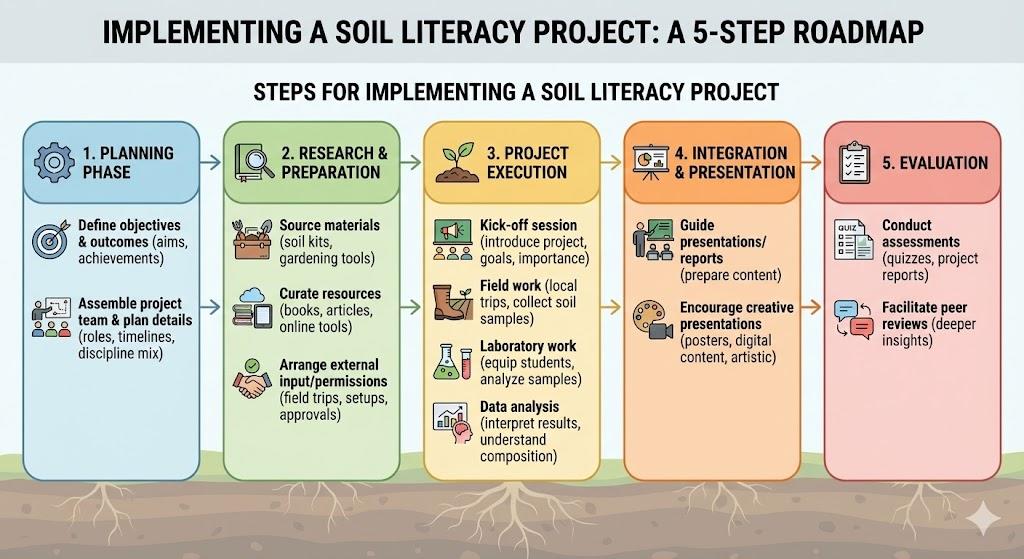
Steps for implementing a soil literacy project
1. Planning phase- Define objectives and outcomes. What do you aim to achieve with the project? - Assemble a project team, including teachers from various disciplines and plan the project details together (including clear roles and responsibilities and timelines). |
2. Research and preparation- Source materials such as soil testing kits and/or gardening tools. - Curate resources like books, articles, and online tools related to soil science. Arrange external input and/or permissions: Obtain necessary people and approvals for field trips or garden setups and other necessary resources. |
3. Project execution- Kick-off session: Introduce the project and its importance in a school assembly or classroom discussion. Discuss project goals and the importance of soil in ecosystems and daily life - Field work: Organize field trips to local parks or agricultural sites. Students should collect soil samples for testing texture, pH, and nutrient levels. - Laboratory work: Equip students with basic lab techniques to analyze soil samples. - Data analysis: Teach students to interpret results and understand soil composition. |
4. Integration and presentationGuide students in preparing presentations or reports. Encourage creative presentations such as posters or digital content like videos, but also include artistic representations. |
5. Evaluation- Conduct assessments through quizzes or project reports. - Facilitate peer reviews for deeper insights.
|
Check out this training (also from an EU funded project) and learn more ideas to train soil stewards.
Write a short reflection on which of these steps you will implement and how.
Which of these steps would you find easiest to implement in your school? And which would be the most challenging? Share why.
 Please log in or register to post a comment