
PARENTAL ENGAGEMENT
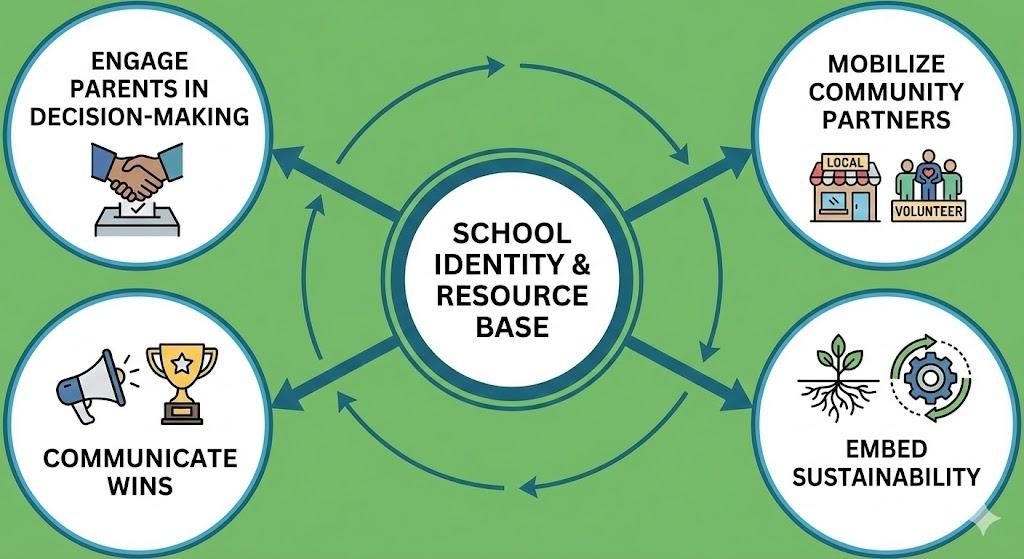
For school heads, soil literacy isn’t just curriculum, it’s community capital. Between budget reviews, parent expectations, and the push for "sustainable schools," you need frameworks that turn soil projects into strategic assets. This module tackles governance: how to deeply engage parents in decision-making, mobilize entire communities as partners, communicate wins to strengthen trust, and critically-embed sustainability so initiatives survive leadership transitions. The goal is to build systems where soil literacy fuels your school’s identity, resource base, and impact long-term.
To promote soil literacy through education, professional educators need to co-operate with the parents and the community, not only because it is impossible to make relevant changes in the thinking of future generations without them, but also because the ecological notion of "everything is linked to everything else” suggests such an approach. In order to achieve such co-operation, school governance (and the governance of education at higher levels) must be transformed significantly so that families and the community can become actively engaged in education policy making and school life. This will lead to children becoming more active citizens who understand the importance of soil. There is a growing consensus on the changing role of school and education that needs a change of approach from educating obedient workers for the assembly line to educating creative, critical thinkers for a world of accelerated change and less need for repetitive work done by people.
Decreasing participation, especially of younger generations as active citizens in community, elections and civic life is a worldwide phenomenon. Participatory practices in schools, engaging parents, children, teachers, and others are effective for school stakeholders to experience active citizenship in a safe environment, as well as the consequences of opting out of decision-making. Both parental engagement and child participation also have a direct positive effect on the learning outcomes of the children and also support the lifelong learning of parents and teachers.
Student and parent organisations have long advocated for participatory decision making in education at all levels, from European and national policy making to daily decisions at school or class level. This demand has only become more topical after the school closures of 2020–22 when the problems of education systems became more visible to parents, and also for students. For many, the need to attend formal education became questionable. Parent organisations have long argued for engagement and participation, and to make school a safe testing field for democratic citizenship skills.
So far, the prevalent approach to citizenship education has been the inclusion of the domain in the curriculum and thus creating the framework for learning about citizenship and democracy. The Curiosoil project is an excellent opportunity to change the main trend of civic/citizenship education from learning about to learning by doing. A meta-analysis study of over 13 000 scientific publications proves that students learn far better if they can experience curricular content rather than just learning about them. This is why the educational materials of the Curiosoil project contain not only hands-on activities, but also elements of parental and community engagement.
This also means that teachers have three very important tasks that hopefully this MOOC can help with:
-
Understand and prepare for their role in supporting parents in general to become better educators of their children as well as more active citizens, starting from school contexts,
-
Understand and prepare for their role in acknowledging child agency and providing opportunities for meaningful participation of children of all ages, and
-
Be active citizens of their own school.
 Please log in or register to post a comment