
SUSTAINABILITY
Module 4.D ensures it outlasts your tenure. Sustainability focuses on embedding soil literacy institutionally: training "Soil Champion" teachers, weaving garden maintenance into facilities budgets, or making soil projects a pillar of new staff orientation. We’ll confront attrition risks head-on, because true sustainability means the garden thrives when you’re pulled into the next crisis meeting.
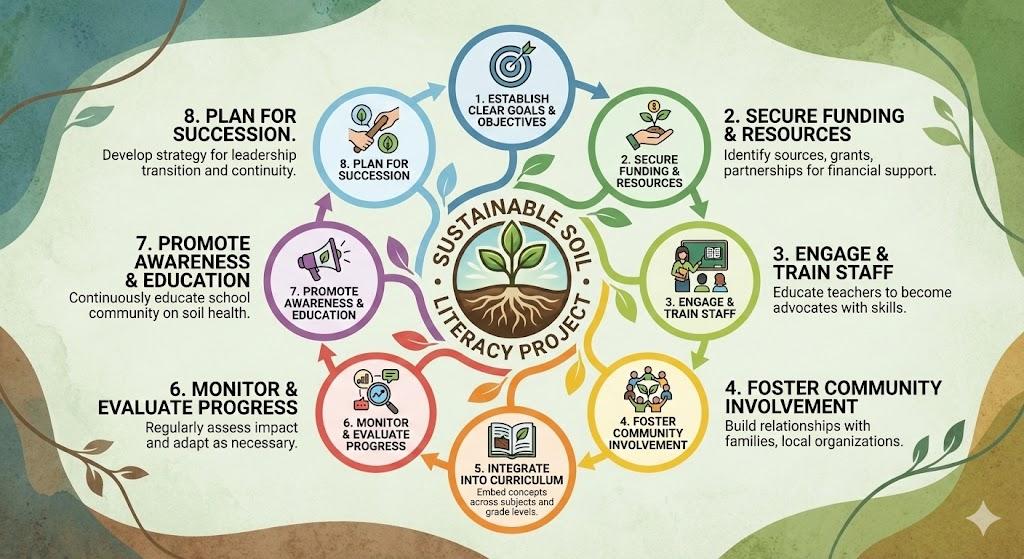
If you have managed to implement a successful project you need to make your success sustainable. Taking the following steps will ensure that your soil literacy project remains effective and sustainable over the long term.
Steps to ensure sustainability:
1. Establish Clear Goals and Objectives:
-
Define the long-term aims of the soil literacy project and how they align with the school’s mission and educational goals.
2. Secure Funding and Resources:
-
Identify potential funding sources, grants, or partnerships to provide financial support and resources needed for the project’s continuation.
3. Engage and Train Staff:
-
Educate and involve teachers and staff to become advocates and facilitators of the project, ensuring they have the necessary knowledge and skills.
4. Foster Community and Stakeholder Involvement:
-
Build strong relationships with families, community members, local organizations, and experts to create a network of support.
5. Integrate into Curriculum:
-
Embed soil literacy concepts into the school curriculum across multiple subjects and grade levels to ensure consistent delivery.
6. Monitor and Evaluate Progress:
-
Regularly assess the project’s impact and effectiveness through student feedback and project metrics and adapt as necessary.
7. Promote Awareness and Education:
-
Continuously educate the school community and promote awareness about the importance of soil health and sustainability.
8. Plan for Succession:
-
Develop a strategy for leadership transition and continuity, ensuring the project can sustain itself beyond the current team’s involvement.
The following checklist will help you make sure that you have considered all major aspects of making your efforts sustainable. Check it out and write a short reflection on which step you find the most problematic and why.
Checklist for long-term sustainability:
-
Set clearly defined goals and objectives aligned with school values.
-
Identify and secure funding sources and partnerships.
-
Provide training and resources for staff to ensure effective project delivery.
-
Build and maintain strong relationships with community and external partners.
-
Incorporate soil literacy into the school’s curriculum.
-
Establish a system for regular monitoring and evaluation.
-
Develop ongoing awareness and educational initiatives.
-
Create a succession plan for leadership and project continuity.
Take a moment to reflect (and share in the forum):
Which of the above steps do you anticipate being the most challenging and why?
Soil governance, done right, can transform your school’s ecosystem. You’ve moved from engaging parents as decision-makers (Section 4.1) to mobilizing the whole community as co-owners (Section 4.2), amplifying impact through targeted communication (Section 4.3), and locking in longevity (Section 4.4). Remember: Your goal isn’t a perfect program, it’s a self-replenishing culture.
When budgets tighten or stakeholders waver, lean on the systems you’ve built. That parent-led soil safety protocol? It’s now policy. The partnership with the local nursery? It’s in the 5-year plan. Your legacy isn’t a garden, it’s the blueprint for how your school turns values into value. Soil teaches us: Depth creates resilience. Dig deep here, and your leadership roots will hold.
 Please log in or register to post a comment