
RISK MANAGEMENT
Empowered teams need guardrails. Section 4, Risk Management, tackles the practical realities that keep school heads awake: What if a student is injured in the garden? What if a compost project triggers parent complaints? We’ll translate anxiety into action, developing checklists for liability, crafting communication templates for controversies, etc.
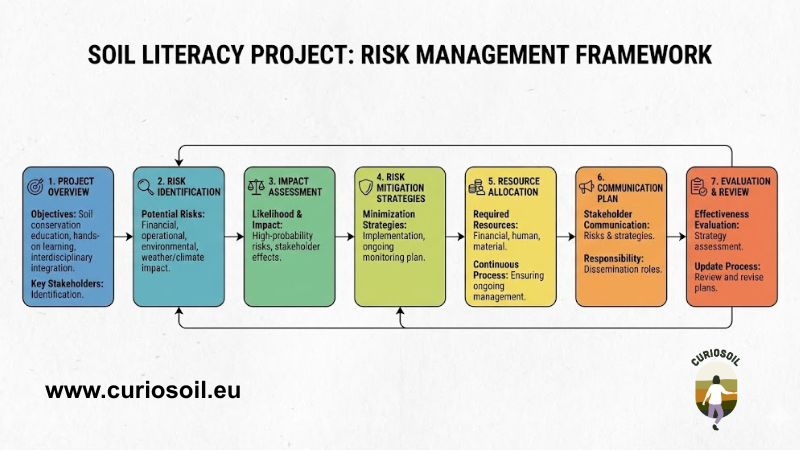
When thinking about implementing a soil literacy project, it is helpful to reflect on risk management. Read and answer the following questions and write a summary of your thoughts.
1. Project Overview:
- What are the main objectives of your soil literacy project? (eg. educate students about soil conservation, health, and sustainability? Provide hands-on learning opportunities through soil testing, gardening, and ecosystem exploration? Integrate soil literacy into multiple subjects (science, geography, health, etc.) to encourage interdisciplinary learning?)
- Who are the key stakeholders involved?
2. Risk Identification:
- What potential risks could affect the implementation of this project (e.g., financial, operational, environmental)?
- Are there any risks related to weather conditions or environmental changes that could impact the project?
3. Impact Assessment:
- Which risks are most likely to occur, and what would be their impact?
- How would these risks affect the different stakeholders involved?
4. Risk Mitigation Strategies:
- What strategies can be implemented to minimize the identified risks?
- How will the project team monitor these risks throughout the project?
5. Resource Allocation:
- What resources (financial, human, material) are required to manage these risks?
- How will you ensure that risk management is a continuous process during the project?
6. Communication Plan:
- How will you communicate risks and mitigation strategies to stakeholders?
- Who will be responsible for disseminating information about risk management updates?
7. Evaluation and Review:
- How will you evaluate the effectiveness of your risk management strategies?
- What process will you use to review and update risk management plans as needed?
Share your thoughts and reflections with others here and check out your peers' reflections too.
Practical Tips:
-
Engage stakeholders early: Involve teachers, students, parents, and community members in the planning stages to identify potential risks from different perspectives.
-
Conduct site analysis: Before starting the project, assess the soil and environmental conditions to anticipate challenges.
-
Pilot small-scale initiatives: Begin with smaller, manageable pilot projects to identify potential issues before a full-scale implementation.
-
Regular monitoring: Establish a schedule for regular check-ins and assessments to ensure the project is on track and risks are mitigated promptly.
-
Flexible planning: Build flexibility into your project timeline and plans to adapt to unforeseen challenges or delays.
-
Documentation: Keep thorough records of all risk assessments, decisions, and changes made during the project to help with future planning and accountability.
Soil literacy, when led with intention, models how to build resilient, inclusive learning communities. Through this module, you’ve moved from ensuring diverse voices shape soil initiatives (Section 1) to leading by learning (Section 2), fostering staff agency (Section 3), and safeguarding progress (Section 4). Remember: Your greatest tool isn’t control, it’s strategic empowerment.
A science teacher troubleshooting soil contamination with students, a custodian mentoring a composting club, or a parent donating rain barrels becomes your leadership legacy. When risks arise (and they will), lean on the systems you’ve built: your inclusive coalitions, your learning-focused culture, your shared ownership. Soil isn’t just underfoot, it’s a mirror of your school’s health. Tend it wisely, and you will cultivate a place where roots run deep, and growth is inevitable.
 Please log in or register to post a comment